

How We Build Yards That Handle Vancouver’s Atmospheric Rivers
Vancouver’s atmospheric rivers can saturate a yard over several days, leaving water sitting on patios, lawns that squelch underfoot and soil pressing hard against retaining walls. These storms are becoming a familiar part of life on the South Coast. This past March, an atmospheric river brought about 150 mm of rain to B.C.’s South Coast, as Global News reported, with rainfall warnings across Metro Vancouver and the North Shore. After every big storm, our phones ring with the same calls: water pooling against the house, a patio that turns into a pond, a garden bed washed into the lawn. The good news is that a yard can be designed and built to handle this kind of rain gracefully. For Vancouver properties, we recommend integrated yard drainage solutions that slow, absorb and safely direct stormwater, using permeable surfaces and planted features wherever the site allows. A drainage plan that looks at the whole property protects your foundation, your outdoor living spaces and your garden, while making better use of the rain that falls.
What We See on Vancouver Properties After a Big Storm
The problems that show up after an atmospheric river tend to follow a pattern, and they almost always trace back to how water moves across the property. Pooling usually forms where the grading creates a low spot or tips runoff toward a patio or the foundation instead of away from it. Older yards often have dense, compacted soil that absorbs water slowly, so lawns stay saturated for days after the rain has stopped. Downspouts that discharge right beside the house concentrate a whole roof’s worth of water in one small area, and when gutters overflow, that water spreads across beds and paving, carrying mulch and soil with it. Sloped North Shore and West Side lots need particular attention, because water gains speed as it runs downhill and saturated soil behind a retaining wall adds serious pressure. We also look for water arriving from a neighbour’s yard or the street, since runoff never follows property lines, and tracing those flows is what separates a simple low spot from a larger drainage pattern.
These are the warning signs we see most often after heavy rain:
- Standing water: puddles on lawns or patios that last more than a day
- Water near the house: runoff pooling against foundations or basement walls
- Washed out beds: mulch and soil carried onto paths and lawns
- Overflowing downspouts: roof water dumping in one spot beside the house
- Leaning walls: retaining walls bulging or tilting after saturated winters
The Drainage Solutions We Build Into Vancouver Landscapes
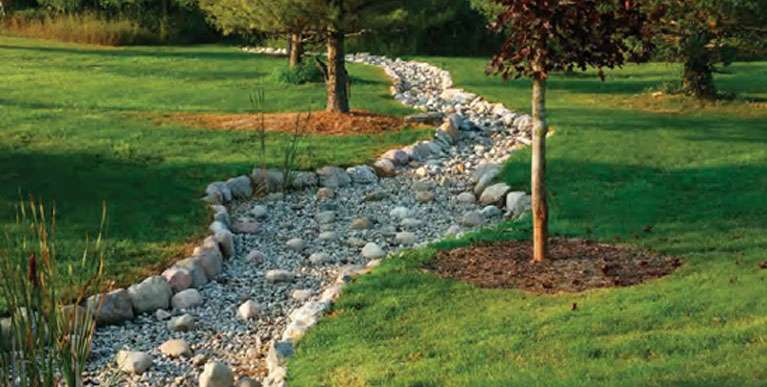
Grading sets the basic direction of flow, guiding water away from the house and toward a suitable collection or discharge point, and it is the foundation of every drainage plan we build. Permeable paving lets rain pass through the surface into a prepared base, where it can soak into the ground instead of sheeting off the patio, which makes it one of our favourite choices for driveways, paths and outdoor living areas. Dry riverbeds and swales give runoff a clear, attractive path through the landscape, slowing moving water and reducing erosion, while a rain garden collects runoff in a planted area designed to absorb it. Retaining walls are built with proper drainage behind them, so water can escape instead of building pressure against the wall. Where the soil cannot absorb everything during a multi day storm, we connect collected water to an approved outlet, giving it a planned route off the property. If you would like to see how these systems work in more detail, our post on rainwater drainage systems that transform a soggy yard walks through French drains and dry creek beds.
Our own projects show how much difference a well designed drainage plan makes. On our award winning Urban Serenity project in Dunbar, a key challenge was adapting the grading and drainage of the site while making sure non irrigated native plants could thrive in changing conditions, and the garden went on to win a BCLNA Landscape Award of Excellence in 2023. On our Refined Reflections project, poor drainage was one of the original problems in a dark, under used yard, and solving it was part of turning the space into a warm outdoor room the homeowners now use in every season. In both cases, drainage was built into the design from the start rather than added after the fact, which is always the most effective and economical approach.

Why Drainage Belongs in the Design From Day One
Water management works best when it is planned together with the patio, planting, walls and paths, because every surface in a landscape affects where rain goes. As a design build team, we trace how water moves across the whole property before we draw a single line, then combine grading, drainage and absorbent planting into one plan. We choose sustainable options that favour permeability, use locally sourced materials wherever possible, and back our work with an industry leading warranty. Fall and winter are also the best times to see exactly where your yard struggles, since the problem areas are easy to spot after each storm.
If your yard turns soggy every time an atmospheric river rolls in, we can help you build a landscape that handles the rain with ease. Learn more about our landscape irrigation and drainage services, and talk to our team about a plan that keeps your Vancouver property dry, safe and beautiful all year.